Southern lights: where and when to see the aurora australis
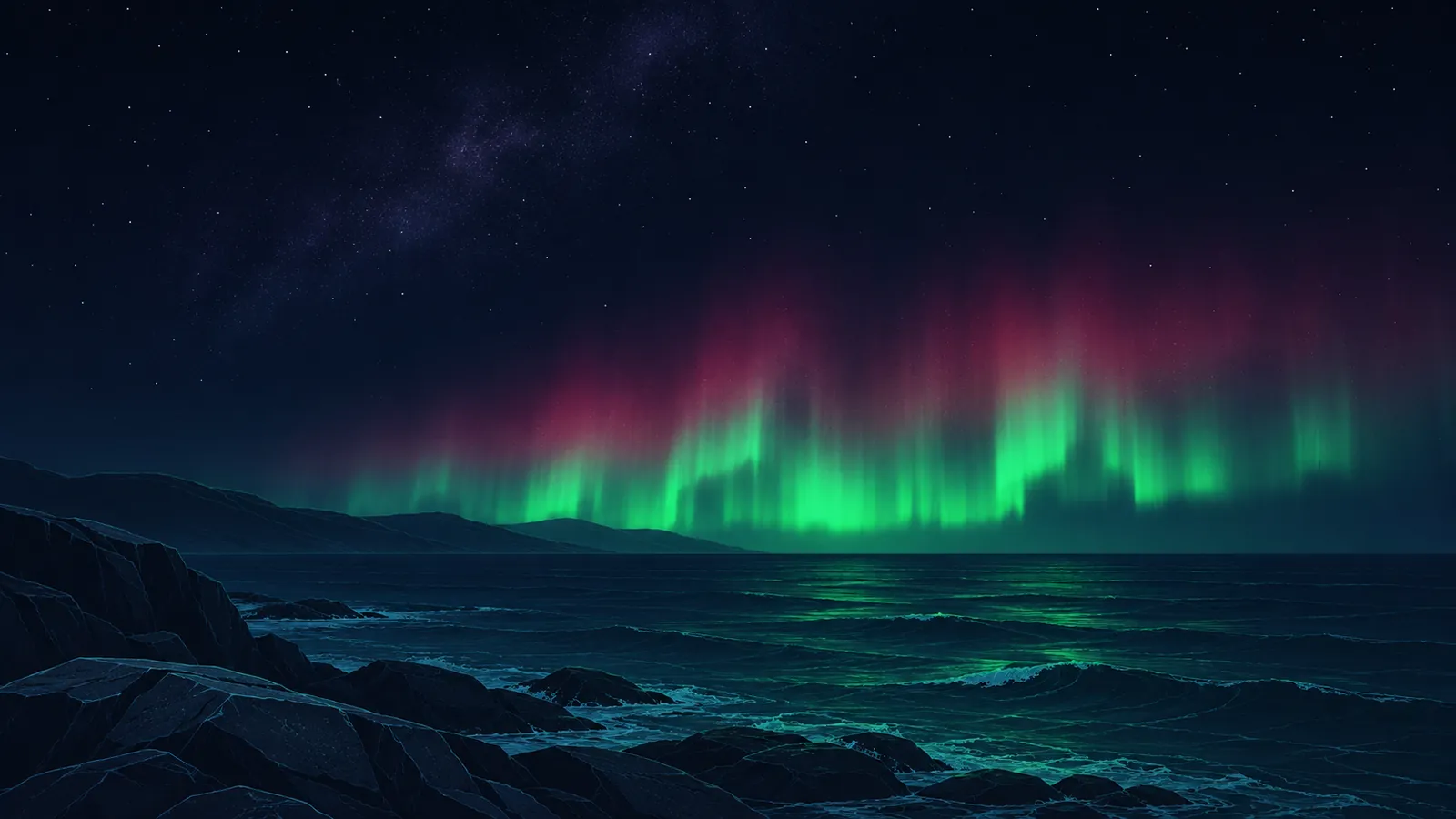
The southern lights, or aurora australis, are the same phenomenon as the northern lights, seen in the southern hemisphere. Tasmania and the south of New Zealand are the most practical places to see the aurora australis; southern Patagonia also sees it, but mainly during strong geomagnetic storms. Look south on dark, clear nights; March to September offers the longest nights. Because there is so little land at high southern latitudes, far fewer people ever see the southern lights.
The same physics, mirrored
The solar wind hits Earth's magnetic field, particles are steered along the field lines toward both poles, and at 100 to 300 kilometres up they make oxygen and nitrogen glow. How that works is explained in what causes the northern lights. The process does not care about hemispheres. When the aurora is active in the north, it is usually active in the south at the same time.
In the south the glow forms a ring around the south geomagnetic pole, the southern auroral oval. That pole is not at the geographic South Pole. It lies inside Antarctica at about 81 degrees south and 107 degrees east, shifted toward the Australian side. It is also not the same as the south magnetic dip pole, which lies off the coast. This offset matters a lot for where you can see the southern lights.
Why the southern lights are rarely seen
In the north, the auroral oval passes over Norway, Sweden, Finland, Iceland, Alaska and Canada, with towns, roads and hotels right underneath. In the south, the same band lies almost entirely over the Southern Ocean and Antarctica. Apart from research stations, nobody lives there.
So the aurora australis is just as frequent as the aurora borealis, but almost always far from people. To see it from inhabited land, you usually need more activity than a traveller in Tromsø does: a raised Kp index or a proper geomagnetic storm. The big storms of 10 May and 10 October 2024 brought the southern lights far north over Australia and New Zealand where many people saw them for the first time.
Where to see the aurora australis
Thanks to the shifted magnetic pole, Tasmania and the south of New Zealand lie closer to the auroral oval than their geographic latitude suggests. Hobart sits at about 43 degrees south on the map, yet it is magnetically closer to the southern oval than Ushuaia, which lies much further south on the map. That is why Ushuaia needs a stronger storm.
Tasmania
- Hobart: beaches and hills south and east of the city, such as the coast toward South Arm, give a free view south.
- Bruny Island: little light, open south-facing coast, a short ferry ride from Hobart.
- Cradle Mountain: dark mountain sky, but often cloudy and cold.
During strong storms the southern lights also reach the south coast of Victoria on the Australian mainland, low on the horizon.
New Zealand
- Stewart Island: the southernmost inhabited island of New Zealand, very dark, with a view across the open sea.
- The Catlins and Invercargill: the wild south coast of the South Island, with south-facing bays and headlands.
- Dunedin: the Otago Peninsula and the beaches around the city are dark within a short drive.
- Lake Tekapo and Mount John: part of the Aoraki Mackenzie International Dark Sky Reserve, one of the darkest skies in the country. Nearby is Aoraki / Mount Cook.
Patagonia
- Ushuaia in Argentine Tierra del Fuego and Punta Arenas in Chile: far south on the map, but further from the magnetic pole. The southern lights appear there mainly during strong storms.
All places with their live traffic light are on the places page. Each place page shows from which Kp value the aurora usually reaches it. In the southern hemisphere these values are an approximation.
Season and time of night
The southern season is the reverse of the northern one. The long, dark nights fall in the southern autumn and winter, roughly March to September. The weeks around the equinoxes in March and September bring geomagnetic storms a little more often. Even around midsummer, Tasmania and southern New Zealand still have several hours of darkness, so the aurora can be seen all year when activity and weather allow; in December and January, viewing simply concentrates around local midnight.
The best hours are the same as in the north: usually between 10 pm and 2 am local time, and during storms right after dusk. noxglim counts an hour as dark when the sun is at least 12 degrees below the horizon. More on timing, clouds and the moon is in the best time to see the northern lights, which applies to the south as well.
What the southern lights look like
Look south, with a free view down to the horizon. From Tasmania or New Zealand you usually see the aurora from far away, at an angle. The lower, green part of the curtain often lies below your horizon, while the upper part, which glows red at heights of 200 kilometres and more, rises above it. That is why the southern lights often appear as a red or pink glow low over the southern horizon, sometimes with pale vertical beams. Only during strong storms does green reach higher into the sky. Why the colours differ is explained in aurora colours.
To the naked eye a faint aurora australis often looks like a grey-white haze. A camera or phone in night mode shows the red and green much more clearly, so take a test shot toward the south whenever the solar wind looks promising.
Frequently asked questions
Where is the best place to see the southern lights?
Tasmania and the south of New Zealand, for example Bruny Island, Stewart Island, the Catlins or Lake Tekapo. Ushuaia and Punta Arenas in Patagonia see the southern lights mainly during strong storms.
When can you see the aurora australis?
All year from Tasmania and southern New Zealand when activity and weather allow. March to September offers the longest nights, while in summer viewing is concentrated around local midnight. The best hours are usually between 10 pm and 2 am local time.
Are the southern lights the same as the northern lights?
Yes. Both are caused by the solar wind and happen at the same time around both magnetic poles. The southern lights are seen less often because there is little land at high southern latitudes.