Geomagnetic storms: what a solar storm means for the northern lights
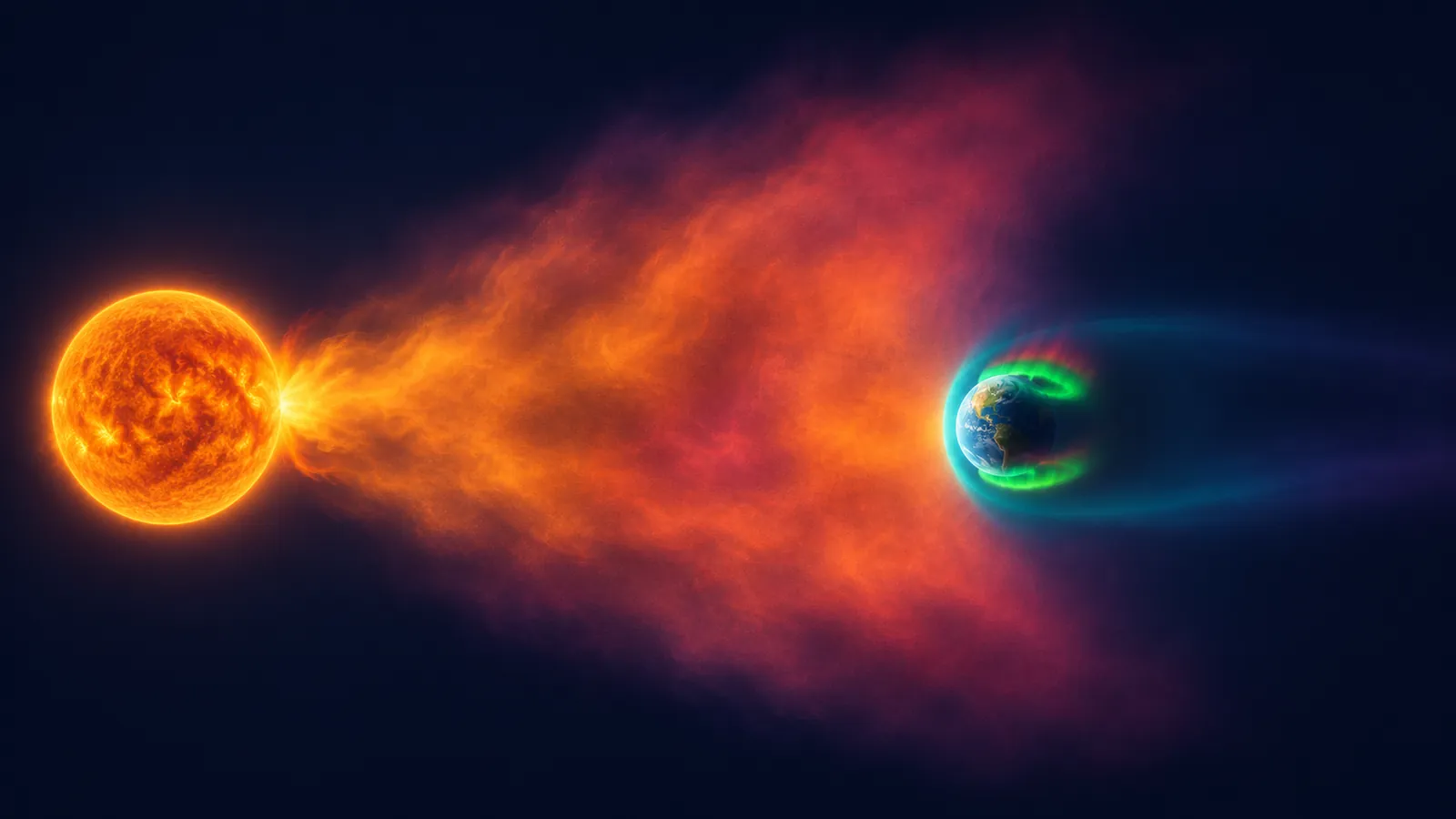
A geomagnetic storm is a strong disturbance of Earth's magnetic field, triggered when a burst of solar wind or a cloud of plasma from the sun hits it. NOAA rates these storms from G1 (minor) to G5 (extreme), which matches Kp 5 to 9. For you as an aurora watcher, a storm means the northern lights move far south, sometimes over regions that see them only a few times per solar cycle.
What a solar storm is
"Solar storm" is an everyday term for several kinds of activity on the sun. Only some of them lead to aurora:
- Solar flares are sudden flashes of radiation from active regions around sunspots. Their light and X-rays reach Earth in about eight minutes and can disturb radio signals on the day side. A flare alone does not cause aurora.
- Coronal mass ejections (CMEs) are clouds of billions of tonnes of plasma that the sun throws into space, often together with a flare. If a CME is aimed at Earth, it usually arrives after about one to three days. CMEs cause almost all strong storms.
- Coronal holes are open regions in the sun's magnetic field that release fast solar wind at 600 to 800 km/s. These streams usually bring G1 or G2 and often return after the 27 days the sun needs for one turn.
How strong a storm gets depends mostly on the magnetic field inside the arriving cloud. If it points south, energy pours into Earth's magnetic field. If it points north, even a fast CME can pass with little effect. The details are in solar wind and Bz.
The NOAA G scale
NOAA's Space Weather Prediction Center rates geomagnetic storms on a five-step scale. Each step corresponds to a Kp index value. The frequencies are NOAA's averages for an eleven-year solar cycle:
- G1, minor (Kp 5): about 1,700 times per cycle. Aurora low on the horizon in northern Germany, Denmark and the northern US states.
- G2, moderate (Kp 6): about 600 times per cycle.
- G3, strong (Kp 7): about 200 times per cycle. Aurora often visible across much of central Europe.
- G4, severe (Kp 8, including 9−): about 100 times per cycle.
- G5, extreme (Kp 9): about four times per cycle. Aurora can reach southern Europe and the southern United States.
NOAA uses two more scales: R for radio blackouts caused by flares and S for solar radiation storms. Neither of them affects the aurora directly. Which Kp value is needed for your region is explained in the article on the Kp index.
Watch, warning and alert
NOAA announces storms in three levels of urgency. Knowing the difference saves you a lot of waiting in the cold:
- Watch: a storm is forecast, usually one to three days ahead after a CME has left the sun. It names the expected G level for each UTC day. Plan, but do not count on it yet.
- Warning: a storm is imminent, for example because a certain Kp is expected within the next hours or a CME shock is about to arrive. Check the sky and the clouds.
- Alert: the threshold has been reached and the storm is happening now. If it is dark and clear where you are, go outside.
The space weather page shows the current NOAA scales and active warnings, updated every five minutes. As a member you can also get an e-mail when a place on your watchlist turns green.
The solar cycle and cycle 25
The sun's activity rises and falls in a cycle of about eleven years. At solar minimum there are hardly any sunspots for months. At solar maximum there are many, and with them more flares and CMEs. At the same time the sun's magnetic poles swap places.
The current cycle 25 began in December 2019. NASA and NOAA announced in October 2024 that the sun had reached its maximum phase, and the peak stretched across 2024 and 2025. Cycle 25 turned out stronger than most early forecasts had expected.
The years after a maximum still bring many storms. Large coronal holes become more common, and some of the biggest storms in history happened in this phase, such as the Halloween storms of October 2003, two to three years after the maximum of cycle 23. Storms are also slightly more frequent around the equinoxes in March and September.
Two recent examples: May and October 2024
On 10 May 2024 a series of CMEs from a large group of sunspots hit Earth one after the other. NOAA declared a G5 storm, the first since October 2003. The aurora was seen across all of Europe down to Spain and Italy, in the United States as far south as Florida, and in the southern hemisphere across Australia and New Zealand. Many people only noticed the colours in their phone photos, because a faint red glow is hard for the eye to see. Why that happens is explained in aurora colours.
On 10 October 2024 a CME that followed a strong flare the day before reached Earth and caused a G4 storm. Once again the aurora appeared over much of Europe and North America, and on the same night far into the south as southern lights.
Both nights show what a storm means for you: the auroral oval moves thousands of kilometres toward the equator, and red becomes the dominant colour. But they also show the limits. Where it was cloudy, people saw nothing at all.
Effects on technology
Strong storms affect technology, mostly in ways that operators expect and prepare for:
- Power grids: changing magnetic fields induce currents in long power lines. In March 1989 a storm caused a blackout of around nine hours in the Canadian province of Quebec. Grid operators now receive warnings and can reduce the risk.
- Satellites: the upper atmosphere heats up and expands, which slows satellites in low orbits. In February 2022 a minor storm caused about 40 newly launched Starlink satellites to re-enter the atmosphere.
- Navigation and radio: GPS can become less accurate, and shortwave radio on polar flight routes can fail. During the May 2024 storm, GPS-guided tractors in the US had to pause during planting.
On the ground, a geomagnetic storm poses no risk to your health. Phones, the internet and everyday life usually carry on as normal, and the main effect you will notice is the sky.
Frequently asked questions
What is a geomagnetic storm?
A geomagnetic storm is a strong disturbance of Earth's magnetic field, usually caused by a cloud of plasma from the sun or a fast stream of solar wind. NOAA rates storms from G1 to G5, matching Kp 5 to 9.
When was the last solar maximum?
The maximum of solar cycle 25 stretched across 2024 and 2025. Strong storms remain common in the years after a maximum, so the chances for aurora far south stay good for a while.
Is a geomagnetic storm dangerous?
Not for your health on the ground. Strong storms can disturb power grids, satellites, GPS and shortwave radio, and operators receive warnings so they can prepare.